
NQ Futures Gap Trading: How to Identify and Trade Overnight Gaps at the Open
Trading Education ·
- What Creates an Overnight Gap in NQ Futures
- The Three Gap Types You Need to Know
- How to Measure the Gap Before the Open
- The Gap Fill Question
- Building Your NQ Gap Trading Framework
- Common Mistakes in NQ Gap Trading
- How Supply and Demand Zones Anchor the Gap Setup
- Putting It Together at the Open
- Frequently Asked Questions
- Start Trading With a Plan Behind Every Setup
The open is the most volatile moment of the trading day — and for NQ futures gap trading, it's also where some of the cleanest setups form. If you've watched the Nasdaq 100 futures open with a significant gap from the prior session's close, you already know how disorienting that first candle can feel. Price is already extended, volume is surging, and every instinct says to chase. Most traders do. Most traders get stopped out within minutes.
This article breaks down how overnight gaps form in NQ futures, how to classify them before the bell, and how to build a repeatable framework for trading the open rather than reacting to it.
What Creates an Overnight Gap in NQ Futures
NQ futures trade nearly 24 hours a day on the CME, from Sunday evening through Friday afternoon. The cash equity market, however, only runs during regular hours. That mismatch is where gaps are born.
When significant news drops after 4:00 PM Eastern — an earnings report from a major Nasdaq component, a Federal Reserve statement, a geopolitical event — NQ futures absorb that information overnight while cash is closed. By the time the 9:30 AM open arrives, NQ may be trading 50, 100, or even 200 points away from where it closed the prior session.
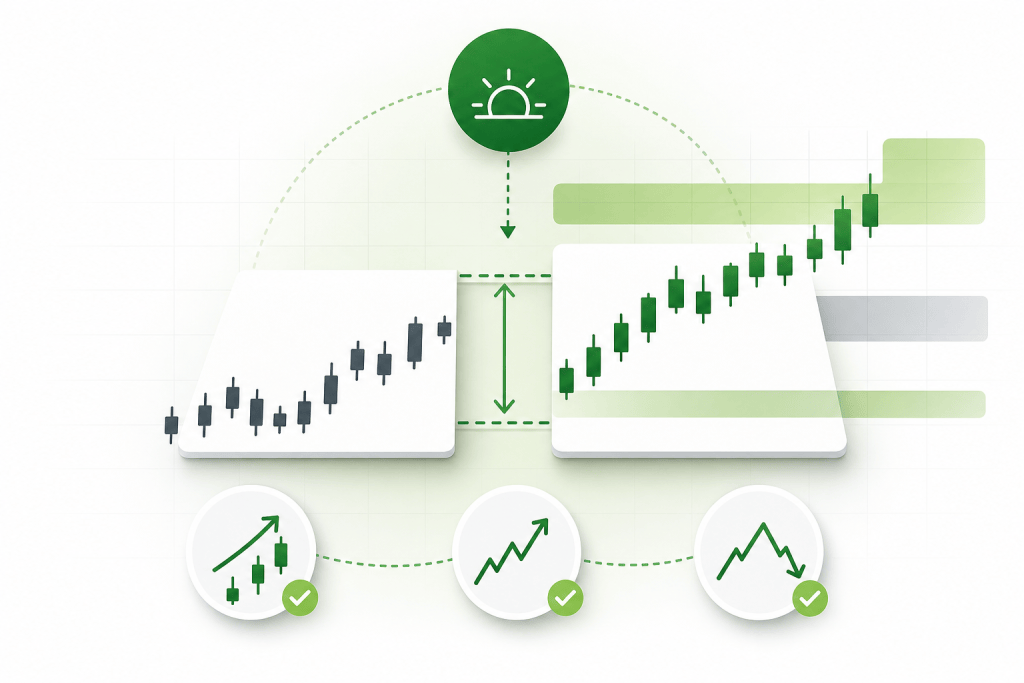
That distance between the prior regular session close and the current open is the gap. It's not noise. It's the market's overnight repricing of risk, and it contains directional information if you know how to read it.
The Three Gap Types You Need to Know
Not every gap trades the same way. Before you place a single order at the open, classify what you're looking at. There are three types that matter for NQ.
Breakaway Gaps
A breakaway gap occurs when price opens beyond a significant supply or demand zone, a prior high or low, or a major technical level that had been holding for days or weeks. These gaps often don't fill quickly — if at all. The overnight move was large enough to clear a structural level, and the market is repricing to a new range.
Fading a breakaway gap at the open is one of the most common mistakes retail traders make. The instinct is there because price looks extended. But if the gap has cleared a multi-day consolidation zone, you're trading against institutional order flow that has already committed. That rarely ends well.
Runaway Gaps
Runaway gaps form in the middle of a trending move. NQ has been trending for several sessions, and overnight it gaps further in the same direction. These are continuation signals — the gap reflects accumulation or distribution that's ongoing, not exhausted.
With runaway gaps, the trade is typically to wait for a pullback into the gap zone after the open, then look for a continuation entry in the trend direction. The gap itself often acts as support or resistance on the first test.
Exhaustion Gaps
Exhaustion gaps are the most dangerous to trade and the most rewarding when you read them correctly. They occur after a prolonged trend, when NQ gaps sharply in the trend direction but volume and follow-through fail to confirm. Price often reverses hard within the first 30 to 60 minutes.
The tell is what happens after the initial push. If NQ gaps up 80 points but stalls within the first 15 minutes and starts printing lower highs, you're likely looking at an exhaustion gap. The fill is coming.
How to Measure the Gap Before the Open
Your pre-market routine should include a gap measurement before 9:00 AM Eastern. Here's the process.
Find the prior regular session close on your NQ chart — the 4:00 PM Eastern close, not the globex session close. Mark that level with a horizontal line. Note where NQ futures are trading at the time of your analysis. The distance between those two levels is your gap size.
Then look at the overnight range. Where did NQ trade during the Asian and European sessions? Is the current price near the top or bottom of that range? A gap that formed at the top of an overnight range with no follow-through is structurally different from one that formed on a clean directional overnight move.
Finally, identify the nearest supply and demand zones on either side of the gap. These are the levels where institutional orders have historically entered the market. If the gap has opened directly into a major supply zone, the probability of a fade increases. If it opened out of a demand zone and is sitting in open air, continuation is more likely.
The Gap Fill Question
Traders spend enormous energy debating whether gaps fill. The honest answer is that some do and some don't — and the classification above tells you which scenario you're more likely in.
What's worth understanding is the statistical behavior of NQ specifically. Because NQ is heavily weighted toward large-cap technology names, it tends to be more reactive to earnings and macro news than ES futures. That means NQ gaps can be more persistent than ES gaps when the catalyst is fundamental rather than technical.
When you're deciding whether to trade for a fill or a continuation, ask two questions. First, what was the catalyst? A single earnings report from one company may produce an overextended gap that's prone to partial fill. A macro event affecting the entire market is more likely to hold. Second, where are the nearest supply and demand zones relative to the gap? A gap that has opened into a clean zone is a much higher-probability fade than one sitting in empty space.
Building Your NQ Gap Trading Framework
A framework isn't a rigid set of rules. It's a decision tree that removes emotion from the first 30 minutes of trading — which is when most retail traders lose money.
Step One: Pre-Market Zone Mapping
Before 9:00 AM, mark the following levels on your NQ chart:
- Prior session close
- Prior session high and low
- Overnight high and low
- Any major supply or demand zones within 150 points of current price
- The gap size in points
Step Two: Gap Classification
Using the criteria above, classify the gap as breakaway, runaway, or exhaustion. If you can't clearly classify it, that's information too. An ambiguous gap is a low-conviction setup, and low-conviction setups should be sized down or skipped entirely.
Step Three: Wait for the First 15 Minutes
The open is chaotic. Market orders, stop runs, and institutional positioning all collide in the first few minutes. Unless you have a specific reason to trade the first candle, don't. Let the market show you its hand.
Watch where the first 15-minute candle closes relative to the gap. Does price push into the gap and hold? Does it immediately reverse? That first 15-minute candle is often the most informative candle of the day for gap traders.
Step Four: Entry Criteria
For a gap fill trade, you want to see price reject from a supply or demand zone near the gap edge and begin moving back toward the prior close. You want a clear candlestick signal — not just a hope that the gap will fill. Entry is at the zone, stop is beyond the zone, and target is the prior session close or the next significant level inside the gap.
For a gap continuation trade, you want to see price hold above or below the gap edge after the first 15-minute candle, then set up a pullback entry. The gap edge becomes your support or resistance. Entry is on the pullback to that level, stop is a close beyond it, and target is the next supply or demand zone in the direction of the gap.
Step Five: Manage the Trade by Structure
NQ moves fast. A 20-point adverse move can happen in 90 seconds. Stop placement should be based on structure — the nearest zone that invalidates your thesis — not a fixed point value. If you're trading a gap fill and price closes above the supply zone you faded, the trade is wrong. Exit it.
Partial profit-taking at the first structural target is standard practice for gap trades. Take half off when price reaches the midpoint of the gap or the first significant zone inside it, then let the remainder run with a trailing stop.
Common Mistakes in NQ Gap Trading
Chasing the open candle. The first candle is a range, not a setup. Trading into it before it closes is guessing.
Ignoring the overnight context. A gap that formed on thin overnight volume is structurally different from one that formed on heavy globex volume. Thin-volume gaps are more likely to fill. High-volume gaps often reflect genuine repositioning.
Overtrading the fill assumption. Not every gap fills the same day. Some fill the same week. Some fill months later. If your gap fill trade isn't working within the first 90 minutes, the market is telling you something. Respect it.
Sizing up on ambiguous gaps. If you can't classify the gap clearly, your position size should reflect that uncertainty. Ambiguity isn't a reason to skip the trade — it's a reason to reduce exposure.
How Supply and Demand Zones Anchor the Gap Setup
Every step in this framework relies on supply and demand zone identification. The gap itself is a manifestation of imbalance between buyers and sellers, and the zones mark where that imbalance has historically resolved.
When NQ gaps into a prior supply zone, you're seeing price return to a level where sellers previously overwhelmed buyers. That context gives the fade trade a structural reason to work. Without it, a fade is just a bet that the move went too far.
This is the same methodology behind the structured daily index setups at Blueville Capital, where supply and demand analysis anchors every trade plan across NQ, ES, SPX, and related instruments. If you want to sharpen your ability to identify these zones in real time, that kind of structured environment accelerates the learning curve significantly.
Putting It Together at the Open
On the morning of a significant NQ gap, your process should feel calm, not urgent. You've done the pre-market work. You know the gap size, the classification, and the key zones. You have a plan for both a fill scenario and a continuation scenario.
When the bell rings, you watch. You let the first 15 minutes develop. You look for confirmation of your thesis — or evidence that the market is doing something different than you expected. Then you act, with a defined entry, a structural stop, and a target grounded in the levels you marked before the open.
That's NQ futures gap trading done right. Not a reaction to the open, but a prepared response to it.
Frequently Asked Questions
What is a gap in NQ futures?
A gap in NQ futures is the difference between the prior regular session close (4:00 PM Eastern) and the price at which NQ opens the following session. It forms when significant news or events move the market overnight while the cash equity market is closed.
Do NQ futures gaps always fill?
No. Breakaway and runaway gaps often don't fill on the same day or even the same week. Exhaustion gaps are the most likely to fill quickly. The gap type, the catalyst, and the surrounding supply and demand structure all influence whether and when a gap fills.
What is the best time to trade an NQ gap?
Most gap setups resolve within the first 60 to 90 minutes of the regular session. Waiting for the first 15-minute candle to close before entering gives you important structural information and reduces the risk of trading into the initial volatility spike.
How large does a gap need to be to trade it?
There's no universal threshold, but gaps smaller than 10 to 15 NQ points often lack the structural significance to set up a clean trade. Larger gaps — 50 points or more — tend to create clearer zones and more defined risk parameters.
What is the difference between NQ and MNQ for gap trading?
NQ is the full-size Nasdaq 100 futures contract, while MNQ is the micro version at one-tenth the size. The gap trading framework is identical for both. MNQ allows traders with smaller accounts — typically in the $25,000 to $50,000 range — to apply the same strategies with proportionally smaller risk per trade.
How do supply and demand zones help with NQ gap trading?
Supply and demand zones mark price levels where institutional order flow has historically entered the market. When a gap opens into one of these zones, it provides a structural reason for the trade rather than a purely pattern-based entry. Zones give your stop placement and target selection a logical foundation.
Can I use this framework for ES futures gaps too?
Yes. The gap classification and zone-based entry framework applies to ES futures as well. ES tends to be less volatile than NQ on a point basis and may have tighter gap ranges, but the same logic around breakaway, runaway, and exhaustion gaps holds across index futures.
Start Trading With a Plan Behind Every Setup
NQ futures gap trading rewards preparation and punishes reaction. The traders who struggle at the open are almost always the ones who skipped the pre-market work and are making decisions in real time under pressure.
If you want to trade index futures and options with a structured daily plan built on supply and demand analysis, explore what Blueville Capital offers across its membership tiers and session-based futures add-on.


