
Options Trading Course Online: What to Expect vs. a Live Alert Service
Trading Education ·
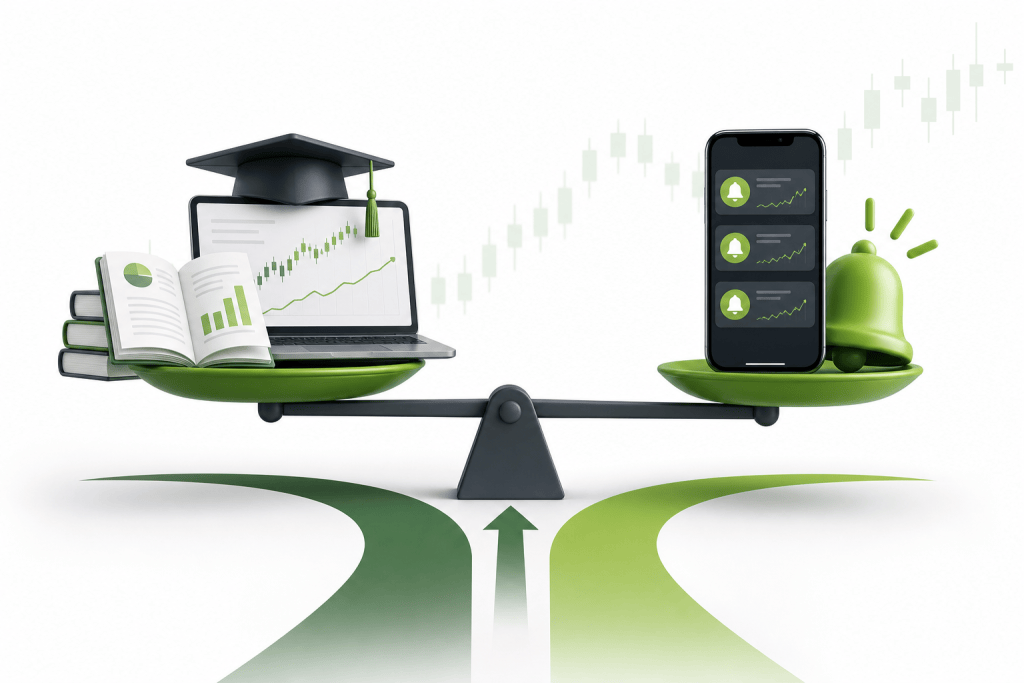
An options trading course online builds the skills (Greeks, volatility, strategy selection) you need to trade independently. A live alert service delivers ready-to-execute setups for traders who want to act now. Neither is universally better: your experience level, available time, and long-term goals should drive the choice.
Options volume hit a record 15.2 billion contracts in 2025, up 26% from the prior year, according to Cboe's 2026 report. More retail traders than ever are entering the market, and most of them face the same first decision: do I learn the craft, or do I follow someone who already has?
Subscribing to alerts gets you into trades. It does not tell you when to exit early, when to size down, or why the setup failed. A course gives you that framework, but it cannot replace live market exposure.
Online Courses vs. Live Alert Services: A Side-by-Side Comparison
The table below maps the key differences so you can match each option to your actual goal.
| Option | Format | Primary Outcome | Best For |
|---|---|---|---|
| Option Alpha | Self-paced video library + bot automation | Options mechanics and strategy understanding | Beginners building foundational knowledge for free |
| Interactive Brokers Traders' Academy | Structured tracks, beginner to intermediate | Derivatives and Greeks literacy | Traders already on the IBKR platform |
| Professional Options Trading Masterclass (POTM) | 18-25+ hours of video, macro-focused | Volatility surfaces and portfolio-level strategy | Experienced traders moving to a professional framework |
| Benzinga Options | Real-time alerts with analysis and live chat | Actionable trade ideas with conviction context | Active traders with larger accounts seeking live setups |
| Bullish Bears | 35-lecture course plus live trading rooms and alerts | Learning while executing real trades | Intermediate traders who want structure and live exposure together |
| Udemy: Options Trading for Rookies | Under 3 hours of video, self-paced | Basic strike price and bid-ask mechanics | Complete beginners who want a low-cost entry point |
What Does an Options Trading Course Online Actually Teach?
A structured options trading course builds the analytical layer that alert services assume you already have.
At the beginner level, a course covers strike selection, expiration mechanics, and the basic risk profiles of calls, puts, and spreads. Option Alpha delivers this through a free video library, though its automation platform requires a paid subscription. Interactive Brokers Traders' Academy offers structured beginner and intermediate tracks covering derivatives and the Greeks, accessible through Coursera or directly on the IBKR platform.
The Professional Options Trading Masterclass goes further, treating options as portfolio instruments rather than isolated trades. It covers options pricing, the Greeks in depth, and volatility surfaces from a macro perspective. At 18 to 25-plus hours of video, it demands a serious time commitment, and the course recommends completing a prerequisite macro course first.
The failure pattern is almost always the same: traders start an advanced course without the foundational volatility literacy to use what they learn. Sequence matters.
What Do Live Options Alert Services Offer Instead?
Alert services do not teach you to fish. They hand you a fish, with a brief explanation of where it came from. That is a real value proposition, but only if you understand what you are holding.
Individual investor involvement in the options market reached 48% in mid-2022, according to the NYSE. The appeal is direct: a real-time setup, the reasoning behind it, and a live chat room to ask questions. No coursework required.
Benzinga Options operates at the premium end of this category. It delivers high-conviction options trade alerts with accompanying analysis and live chat rooms focused on actionable ideas rather than curriculum. That context is not a substitute for understanding volatility or gamma risk on your own.
Bullish Bears pairs a 35-lecture options course with live trading rooms, real-time alerts, and community feedback. The emphasis is on learning while trading, which compresses the timeline but also compresses the depth. The course component does not reach the depth of a dedicated professional program, but the hybrid format suits traders who want live exposure without abandoning structured learning entirely.
The trade-off with any alert service is execution without deep understanding. You can follow a setup correctly and still not know why it worked, or why the next one did not.
Are Free Options Trading Course Resources Worth It?
Free resources are a legitimate starting point, not a complete education.
Option Alpha covers mechanics and advanced strategies through its video library at no cost. Interactive Brokers Traders' Academy offers free structured tracks for beginners and intermediate traders through its platform and Coursera. Both are worth using before committing to a paid program.
The gap free resources do not fill is live market context. Recorded lessons explain concepts in stable conditions but cannot show you how volatility expansion changes your spread's risk profile in real time. If you have worked through the free material and still hesitate at execution, that hesitation is structural, not a gap another free video will close.
Why Do So Many Retail Options Traders Lose Money?
SEBI research found that only 1% of individual traders achieved profits greater than ₹1 lakh after accounting for fees. That figure comes from Indian retail market data, but the underlying dynamic applies broadly: most retail traders lose money regardless of whether they used a course or an alert service. The failure pattern is about risk management, position sizing, and the discipline to follow a pre-built setup rather than improvising.
Paper trading before committing real capital is not optional for beginners. It is where you find out whether you can follow a defined process under simulated pressure before real losses create emotional interference. No course or alert service removes that requirement.
How to Choose: Course, Alerts, or a Hybrid Approach?
Match the format to your current gap, not your ideal outcome.
- If you cannot explain why a trade is sized the way it is, start with a course. Option Alpha's free library or IBKR Traders' Academy covers the foundation without cost.
- If you understand the mechanics but lack live setups, an alert service gives you real-time exposure to how experienced traders structure trades on SPX, RUT, SPY, and IWM.
- If you want both, a hybrid membership that combines daily trade alerts with one-on-one instruction closes both gaps at once.
Blueville Capital delivers daily index and stock options trade setups on SPX, RUT, SPY, and IWM using supply and demand analysis. Members receive live trade alerts, market data, and performance tracking, with one-on-one instruction available for traders who want structured guidance alongside execution. Before committing to any service, it helps to understand how many trade alerts per day is normal for an index options service.
Prices and plan limits verified as of October 2026.
FAQs
Which is the best options trading course online for complete beginners?
Option Alpha's free video library is the most accessible starting point for beginners, covering mechanics and basic strategy without cost. Interactive Brokers Traders' Academy adds structured derivative and Greeks tracks through Coursera. Both are worth completing before spending money on a paid program. The best paid option depends on whether you want depth (POTM) or a combination of course and live alerts (Bullish Bears).
Can I make consistent daily income from options trading alerts alone?
Not reliably, and not without understanding what you are trading. Alerts give you setups, not judgment. If you cannot evaluate whether a setup still makes sense after the alert fires, you will take entries you should skip and hold positions past their structural reason. Alerts are most useful to traders who already understand volatility, defined risk, and position sizing.
What is the role of paper trading before using real money?
Paper trading lets you test whether you can follow a defined process without the emotional interference of real losses. It does not replicate the psychology of live trading, but it does expose gaps in your execution discipline before those gaps cost real capital. Treat it as a required step, not an optional warm-up.
How long does it take to complete a professional options trading course?
The Professional Options Trading Masterclass runs 18 to 25-plus hours of video content and recommends a prerequisite macro course. Realistically, working through it at a serious pace takes several weeks. Shorter introductory courses like Udemy's Options Trading for Rookies run under three hours but cover only basic mechanics, not volatility surfaces or advanced Greeks.
Is an advanced options trading course necessary before subscribing to an alert service?
Not necessarily, but foundational literacy is. You do not need to complete a full professional course before using an alert service, but you do need to understand the Greeks, basic spread mechanics, and how to size a position relative to your account. Without that, you will follow alerts into trades you cannot manage when conditions change.
Conclusion
A course builds the analytical framework you need to trade independently. An alert service delivers execution-ready setups for traders who already have that framework, or are building it in parallel. They address different gaps, and the right starting point depends on which gap is holding you back.
If you hesitate at execution because you do not understand the setup, start with education. If you understand the mechanics but lack live market exposure to structured setups on SPX or RUT, an alert service or hybrid membership is the more direct path.


