
What Is a One-on-One Options Coaching Session and Who Should Enroll?
Trading Education ·
- What a One-on-One Options Coaching Session Actually Is
- How Private Coaching Differs from Alert Services and Courses
- Who Should Enroll in Private Options Coaching
- What to Look for in an Options Coaching Program
- How to Get the Most from a Coaching Session
- The Coaching and Alert Combination
- Frequently Asked Questions
Most options traders hit a wall somewhere between "I understand how calls and puts work" and "I can actually do this consistently." You know the mechanics. You've read the books, watched the videos, maybe even paper traded for months. But your account still bleeds on the weeks where nothing clicks, and you can't always explain why.
That gap is exactly where one-on-one options trading coaching lives. This article breaks down what a private coaching session actually involves, how it differs from courses and alert services, and how to know whether you're at the right stage to benefit from it.
What a One-on-One Options Coaching Session Actually Is
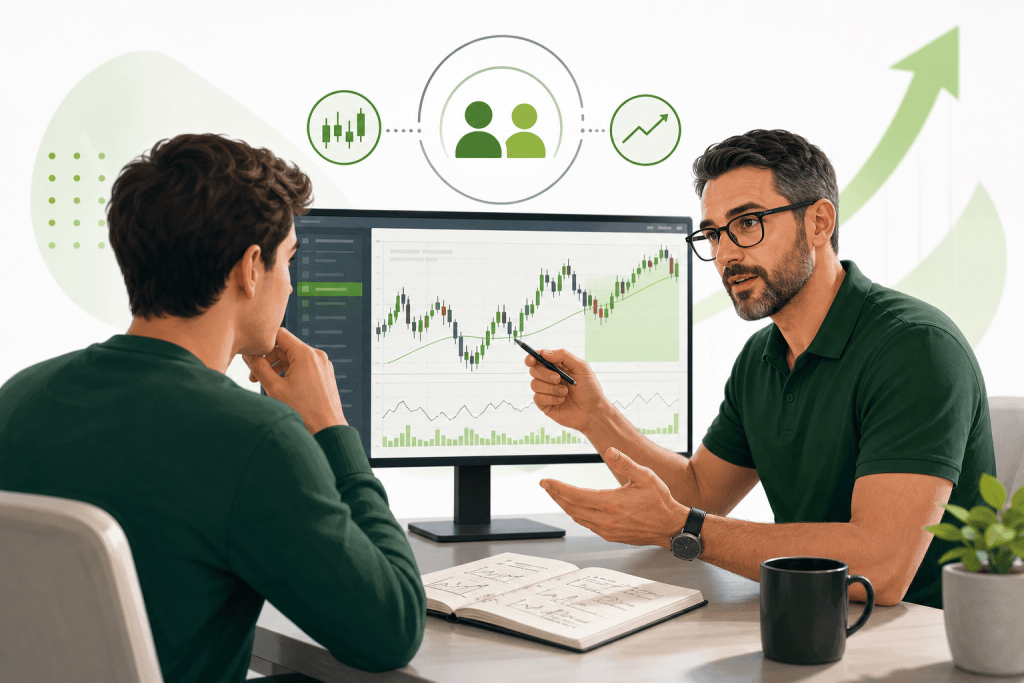
A private coaching session is a live, structured conversation between you and an experienced trader — focused entirely on your specific questions, setups, and gaps. It's not a recorded course you watch at 1.5x speed. It's not a Discord channel where someone drops a ticker and disappears. It's not a group webinar where your question gets buried in the chat.
The format matters because options trading is deeply personal. Your account size, your schedule, your risk tolerance, and your current knowledge base all shape what you need to work on. A group course teaches to the median student. A private session teaches to you.
What Typically Happens During a Session
Structure varies by mentor, but a well-designed session usually covers:
- Review of your recent trades. Where did you enter? Where did you exit? What was your reasoning at the time, and does it hold up under scrutiny?
- Methodology walkthrough. The mentor demonstrates how they identify setups, including the specific logic behind entry and exit decisions.
- Live or recorded chart analysis. Walking through supply and demand zones, key levels, or spread construction on actual charts — not abstract diagrams.
- Q&A on your specific confusion points. Whether that's managing a losing position, sizing for your account, or understanding why a clean-looking setup still failed.
- A framework you can apply independently. The goal isn't to make you dependent on the mentor. It's to give you a repeatable process.
At Blueville Capital, the Classes and Mentoring package is built around four two-hour one-on-one video sessions covering supply and demand strategies. That's eight hours of direct, private instruction. It also includes unlimited mentor access during market hours — meaning you're not left to figure things out alone between sessions. That kind of live-market availability is rare. Most education products deliver pre-recorded content and leave you to apply it without any real-time support.
How Private Coaching Differs from Alert Services and Courses
Understanding the difference helps you figure out what you actually need right now.
Alert Services
An alert service sends you trade signals — sometimes with a strike and expiration, sometimes with a brief rationale. The best ones include the reasoning behind the trade. The worst drop a ticker and go silent.
The problem with relying solely on alerts is that you never build the skill to identify setups yourself. If the service goes dark for a week, or you miss a fill by a few cents, you have no framework to fall back on. You're renting someone else's judgment rather than developing your own.
Pre-Recorded Courses
Courses are useful for foundational knowledge. They're efficient for learning mechanics — how spreads work, what the Greeks mean, how to read an options chain. But they're static. They can't respond to your specific misunderstanding or watch you analyze a chart and tell you exactly where your logic breaks down.
One-on-One Coaching
Private coaching sits in a different category entirely. It's interactive, adaptive, and focused on your actual trading behavior. A good mentor watches how you think, not just what you know. They can identify the specific pattern that's costing you money — whether that's entering too early, sizing too large, or exiting profitable trades before they hit target.
The tradeoff is cost and availability. Private coaching runs more expensive per hour than a course, and good mentors have limited time. That's why it works best when you're past the absolute beginner stage and have enough trading history to make the sessions genuinely productive.
Who Should Enroll in Private Options Coaching
Not everyone is at the right stage. Here's how to think about fit.
You’re Past the Basics but Not Yet Consistent
If you still need someone to explain what a debit spread is, start with a course. But if you understand the mechanics and you're still losing money — or you're profitable some weeks and blown out on others — that inconsistency is exactly what private coaching is designed to address.
The trader who benefits most from one-on-one coaching typically has one to three years of active options trading experience. They've placed real trades with real money. They have a trade history to review. They can describe their strategy, but they can't always explain why it works when it does or falls apart when it doesn't.
You’re Trading Index Options and Want a Specific Framework
Generic coaching that covers a little bit of everything rarely produces the same results as coaching built around a defined methodology. If you're focused on SPX, RUT, SPY, or IWM, you want a mentor who actually trades those instruments and can walk you through setup identification in that specific context.
Supply and demand zone analysis, for example, has real mechanical specifics: how zones are drawn, how they're validated, when they're invalidated, and how to size a position relative to the zone. Learning that framework in a live session with someone who applies it daily is fundamentally different from reading about it in a PDF.
You’ve Had a Loss Streak You Can’t Explain
A string of losses you can't diagnose is one of the clearest signals that you need outside feedback. When you're inside your own trading decisions, it's hard to see the pattern. A mentor who reviews your trade log with fresh eyes can often identify a systematic error within the first session.
Sometimes it's structural — consistently buying options with too little time value. Sometimes it's behavioral — cutting winners short while letting losers run. Either way, identifying it clearly is worth more than any single trade signal.
You Want to Build Independence, Not Dependency
The right coaching relationship makes you less reliant on external signals over time, not more. If your goal is to develop a method you can apply on your own, private coaching accelerates that process in a way that a signal service simply can't.
Some traders want a signal service because they don't want to spend time developing a methodology. That's a legitimate choice. But if your goal is to identify SPX setups before the market open without waiting for someone else's alert, coaching is the faster path to that outcome.
What to Look for in an Options Coaching Program
Before enrolling anywhere, ask these questions:
Does the mentor trade the same instruments you want to trade? Coaching from someone who primarily trades equities won't give you the index options depth you need.
Is the methodology clearly defined? You should be able to describe the approach after the first session. If it's vague or shifts from session to session, you're not learning a framework — you're just getting opinions.
Is there access between sessions? Four sessions spread over a month with no contact in between limits how much you can actually apply and test. Unlimited access during market hours is a meaningful differentiator.
Is there a performance record you can review? A mentor who publishes trade logs gives you something concrete to evaluate. Blueville Capital maintains publicly viewable performance logs for both index spreads and stock trades, so you can assess the methodology on its actual record before committing to coaching.
Is the coaching structured around your account size? A $10,000 account and a $200,000 account require different position sizing, different spread structures, and different risk management approaches. A program that ignores account size is teaching theory, not practice.
How to Get the Most from a Coaching Session
Preparation matters more than most traders expect.
Bring a trade log. Even a simple spreadsheet with your last 20 to 30 trades — entry, exit, and your reasoning at the time — gives the mentor something concrete to work with. The more specific your questions, the more useful the session.
Come with a setup you don't understand. Whether it's a trade that looked perfect and failed, or a setup you keep second-guessing before entry, specific examples are far more productive than general questions like "how do I get better at options."
After each session, document what you learned and apply it in at least three to five trades before the next one. The feedback loop between instruction and application is what produces lasting skill development — not the session itself.
The Coaching and Alert Combination
For many traders, the most effective approach isn't coaching or alerts — it's both together. Alerts give you live exposure to how a methodology is applied in real market conditions. Coaching gives you the private feedback to understand why specific decisions were made and how to replicate them on your own.
That combination is central to what Blueville Capital is built around: daily index options trade setups with the supply and demand reasoning behind each one, paired with private mentoring for members who want to develop the skill to identify those setups independently. The 50%+ profit target on SPX, RUT, SPY, and IWM plays is stated as a goal on each setup — not a guarantee — and the publicly viewable trade logs let you evaluate the methodology on its actual results.
If you're at the stage where you're ready to move from following alerts to understanding them, the Classes and Mentoring package at Blueville Capital is built for exactly that transition.
Frequently Asked Questions
What is a one-on-one options coaching session?
A one-on-one options coaching session is a private, live meeting between a trader and an experienced mentor focused on the trader's specific setups, trade history, and knowledge gaps. Unlike courses or group webinars, the session is fully personalized and interactive.
Who benefits most from private options trading coaching?
Traders with one to three years of experience who understand options mechanics but aren't yet consistently profitable benefit most. If you have a trade history to review and specific questions you can't answer on your own, you're at the right stage for private coaching.
How is one-on-one coaching different from an options alert service?
An alert service delivers trade signals, sometimes with reasoning and sometimes without. Coaching builds your ability to identify setups yourself. The goal of coaching is independence; the goal of an alert service is execution support. Many traders use both together.
How many sessions do I need to see results?
That depends on your starting point and how actively you apply what you learn between sessions. A structured program like four two-hour sessions, combined with unlimited mentor access during market hours, gives you enough time to learn a methodology and test it under real market conditions.
What should I bring to a coaching session?
A trade log with your recent entries, exits, and reasoning is the most useful preparation. Specific setups you've struggled with, questions about a methodology you're trying to learn, and an honest account of where your losses are coming from will all make the session more productive.
Is options coaching worth it for smaller accounts?
Yes, particularly when the coaching is matched to your account size. A mentor who understands how to apply supply and demand analysis on a $5,000 to $25,000 account will give you more actionable guidance than generic instruction designed for much larger portfolios.
How do I evaluate a coaching program before enrolling?
Look for a clearly defined methodology, a mentor who trades the instruments you want to trade, access between sessions during market hours, and a publicly available performance record you can review. Avoid programs that promise specific returns or rely on vague "proprietary" methods they won't explain in advance.
The gap between knowing options and trading them consistently is real, and it's rarely closed by more information alone. Private coaching closes it faster than most other approaches because it responds to how you specifically think and trade. If you're ready to build a repeatable framework rather than chase signals, explore what's available at Blueville Capital.


